 920002157
 support@bontech.sa


Opening a restaurant in Saudi Arabia can be an excellent business opportunity. If you want to understand how to open a restaurant in Saudi Arabia, you need more than a promising menu and an attractive location. You need a clear business plan, the right licenses, a realistic budget, and reliable systems to manage daily operations. This guide covers the market opportunity, legal requirements, startup costs, and technology that can help you build a profitable restaurant in 2026.
Why Open a Restaurant in Saudi Arabia?
Saudi Arabia offers restaurant owners a compelling combination of growing cities, diverse dining preferences, and a market where convenience plays an increasingly important role. However, entering this market without understanding your customers, competition, and operating costs can quickly turn an exciting investment into a financial burden.
A Market With Room for Different Restaurant Concepts
You do not need to open a large, full-service restaurant to compete. Saudi Arabia offers opportunities for specialty coffee shops, casual dining concepts, bakeries, fast-casual restaurants, delivery-focused kitchens, and premium dining experiences.
Read more about cloud kitchens in Saudi Arabia
Your strongest opportunity depends on the customers you want to serve. For example, a café near offices may benefit from quick service and a loyalty program, while a family restaurant may need efficient table management, reservations, and a menu that appeals to different age groups.
Saudi Arabia's Vision 2030 program also places significant emphasis on tourism, entertainment, and improving the quality of life. These priorities support the wider hospitality sector, although demand and profitability still vary by location and concept.
The key is to identify a specific customer need and build your restaurant around it. A clear concept gives you a stronger foundation for pricing, marketing, staffing, and long-term growth.
Digital Ordering and Convenience Create New Opportunities
Customers expect convenient ordering, accurate bills, and consistent service. Depending on your concept, they may want to order at the counter, scan a QR code, reserve a table, or order through a delivery platform.
These expectations create opportunities for restaurant owners who combine good food with efficient operations. Digital tools can also help you understand which dishes sell best, when your restaurant gets busiest, and where you may be losing revenue.
For example, a restaurant that tracks sales by item can identify popular dishes and adjust purchasing accordingly. A café that monitors repeat visits can develop more relevant promotions instead of spending money on discounts that fail to bring customers back.
Your advantage comes from running the business as carefully as you develop the menu. When you understand your customers and your numbers, you can make better decisions and respond to changing demand.
How to Open a Restaurant in Saudi Arabia: Step-by-Step Legal Process
Understanding how to open a restaurant in Saudi Arabia starts with choosing the correct business activity and confirming the legal requirements before you commit to a property or begin renovations.
Step 1: Define Your Concept and Business Structure
Start by deciding what you will serve, who your customers will be, and how your restaurant will operate. Will you open a dine-in restaurant, a takeaway outlet, a specialty café, or a delivery-focused kitchen?
Your answers will influence the premises you need, your staffing requirements, equipment purchases, and licensing process. You should also choose an appropriate legal structure and confirm which business activities need to appear in your commercial registration.
Step 2: Meet Food Safety and Staffing Requirements
Your restaurant must comply with the applicable food safety, hygiene, and employee requirements before opening. Depending on your operation, this may include food-handling procedures, suitable storage and refrigeration, pest control, cleaning arrangements, and the required health certificates for food handlers.
Step 3: Set Up Tax, Payments, and E-Invoicing
Before your first sale, make sure your business has the necessary tax arrangements, payment methods, and invoicing processes in place. Your VAT registration obligations depend on the applicable rules and your business's circumstances. The goal is to open with your legal and operational requirements aligned, rather than trying to fix gaps after customers arrive.
Request a demo of BonTech’s restaurant POS system
How to Start a Business in Saudi Arabia for Foreigners
If you are an international entrepreneur, Saudi Arabia may offer attractive opportunities, but you must confirm the rules that apply to your nationality, ownership structure, and proposed activity before investing.
Understand the Foreign Investment Registration Process
The Kingdom's updated Investment Law introduced a registration-based framework for foreign investors, replacing the previous general foreign investment licensing framework. Under the published rules, foreign investors must register with the Ministry of Investment of Saudi Arabia (MISA) before engaging in investment activities, subject to the applicable regulations and exceptions. After registration is completed, investors can proceed with commercial registration and obtain the relevant approvals.
For anyone researching how to start a business in Saudi Arabia for foreigners, the practical steps are:
Confirm that your proposed restaurant activity is available to foreign investors and whether any additional approval applies.
Determine the appropriate legal entity and ownership structure.
Complete the applicable MISA registration process.
Obtain commercial registration and the required activity-specific licenses.
Arrange tax registration, banking, employment, and other operational requirements.
You should verify the latest requirements directly with MISA and the relevant licensing authorities before committing funds.
Prepare for the Financial and Operational Requirements
Legal registration is only one part of the process. You must also account for lease commitments, equipment, recruitment, supplier contracts, and working capital.
If you plan to manage your restaurant remotely, operational visibility becomes particularly important. A connected system that lets you review sales, stock, and business performance can help you monitor the operation without relying entirely on manual reports.
Foreign ownership can open the door to the market, but careful planning and reliable local operations are what help you build a sustainable business.
Cost of Opening a Restaurant in Saudi Arabia
The cost of opening a restaurant in Saudi Arabia depends on your concept, city, location, size, equipment, and level of fit-out. A small takeaway operation and a large restaurant with a commercial kitchen have very different financial requirements.
What Makes Up the Cost to Open a Restaurant?
Your budget should cover both the initial investment and the money required to keep the business running while sales grow.
Expense category | What you need to budget for |
|---|---|
Rent and deposit | Advance rent, security deposits, and any applicable lease-related charges |
Fit-out and construction | Flooring, lighting, plumbing, electrical work, ventilation, and interior finishes |
Kitchen equipment | Ovens, refrigeration, cooking equipment, preparation stations, and storage |
Furniture and signage | Tables, chairs, counters, menus, exterior signs, and décor |
Licensing and compliance | Registration, municipal licensing, safety requirements, and applicable permits |
Staff and training | Recruitment, salaries, uniforms, onboarding, and training |
Initial inventory | Ingredients, beverages, packaging, and cleaning supplies |
Technology | POS, kitchen display screens, payment equipment, inventory tools, and reporting |
Working capital | Rent, payroll, utilities, supplier payments, and other operating expenses during the early months |
How to Build a Realistic Restaurant Budget
To estimate the cost to open a restaurant, request supplier quotations, compare properties, and separate one-time setup expenses from recurring costs. You should also allow for unexpected expenses and a slower-than-expected sales ramp-up.
Your budget should answer three questions:
How much money do you need before opening day?
How much will it cost to operate each month?
How much revenue must you generate to cover expenses and reach your target profit?
Never treat your opening budget as the entire investment. Keeping enough working capital available can make the difference between surviving the first few months and being forced to cut essential costs.
Read more about managing restaurant food costs
Choose Technology That Supports Daily Operations
The right restaurant management system can make your operation easier to control as order volumes increase. Instead of managing sales, kitchen tickets, stock, and reports separately, you can connect these activities through one platform.
Consider the following tools when deciding how to start a restaurant business:
Point of Sale (POS): Record sales, process payments, and issue invoices.
Kitchen Display System (KDS): Send orders to the kitchen and help staff manage preparation.
Inventory management: Monitor stock movement and improve purchasing decisions.
Table management: Organize seating, reservations, and table availability.
QR ordering: Give customers a convenient way to browse menus and place orders.
Loyalty and reporting: Encourage repeat visits and measure sales performance.
These tools are particularly useful when you manage several service channels or plan to expand. For example, if your café serves walk-in customers and delivery orders simultaneously, a connected ordering process can help staff coordinate demand and reduce avoidable errors.
BonTech brings these functions together in one restaurant management platform, with integrations for delivery platforms, payments, and accounting tools. Its offline selling capability also helps operations continue during an internet interruption, with data syncing when connectivity returns.
How BonTech Helps New Restaurant Owners in Saudi Arabia Launch and Grow
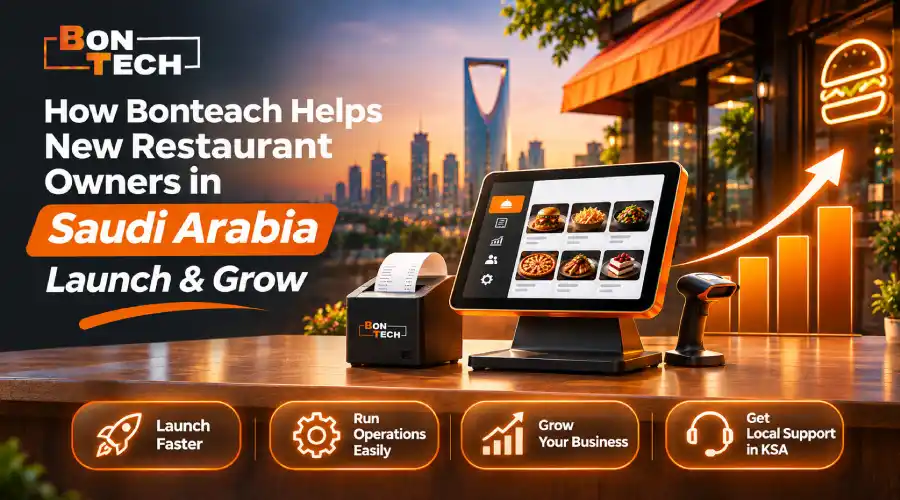
BonTech brings POS, table management, kitchen display systems, QR ordering, inventory, loyalty, and reporting together in one platform. With over 5 years in the market, more than 16 million sales processed, and 450,000 successful transactions, BonTech supports restaurants across Saudi Arabia. Its ZATCA e-invoicing compliance, integrations, and 24/7 expert support help you manage daily operations with greater control. Book a demo at BonTech to explore the right setup for your restaurant.