 920002157
 support@bontech.sa

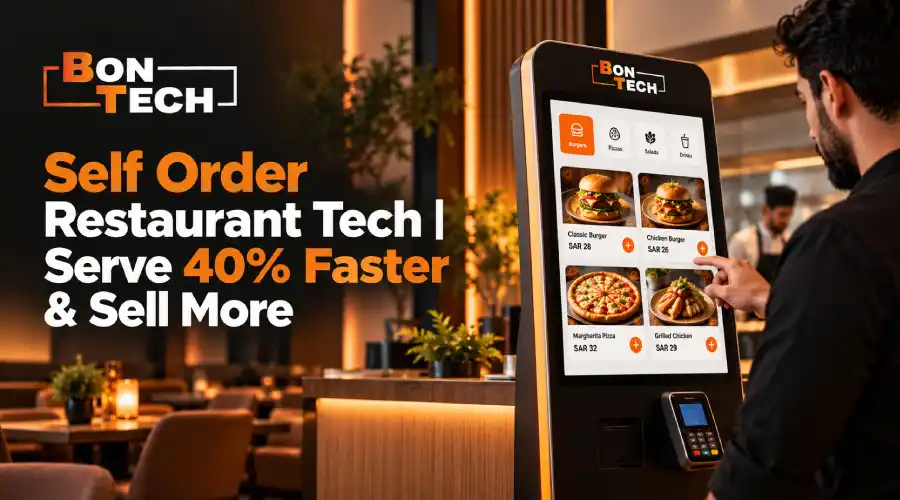
Long queues, rushed orders, and missed upselling opportunities can quickly hurt your restaurant’s revenue and customer experience. A self order restaurant model gives your customers more control while helping your team handle busy periods with greater speed and accuracy. In this guide, you’ll discover how restaurant self-ordering works, the main systems available, the benefits for single and multi-location businesses, and how modern technology such as AI and data can shape your next stage of growth.
What Is a Self Ordering Restaurant System?
A self-ordering restaurant system allows your customers to browse your menu, customize their orders, and, depending on the setup, pay without relying entirely on a cashier or server to enter every detail.
Instead of waiting for an employee to take an order manually, your customer can interact directly with a digital menu through a QR code, tablet, kiosk, or mobile experience. Once the order is placed, it can move directly into your restaurant’s POS and kitchen workflow.
That sounds simple, but the operational impact can be significant.
When your team is dealing with a lunch rush, every unnecessary step creates another opportunity for a delay. A customer explains an order, the employee enters it, the customer checks it, the order reaches the kitchen, and someone may need to clarify a modification. A restaurant self-ordering system removes several of these steps by allowing the customer to enter their own choices.
Research into self-service ordering has also found that system quality can influence customers’ expectations around speed, accuracy, and ease of use.
For your restaurant, this means technology is not simply replacing a manual ordering step. It is creating a smoother connection between the customer, your front-of-house team, your POS, and your kitchen.
And when all these parts work together, your staff can spend less time entering orders and more time delivering the experience your customers actually remember.
Book a free trial of Bontech Restaurant Management System
3 Types of Self-Ordering Systems for Restaurants
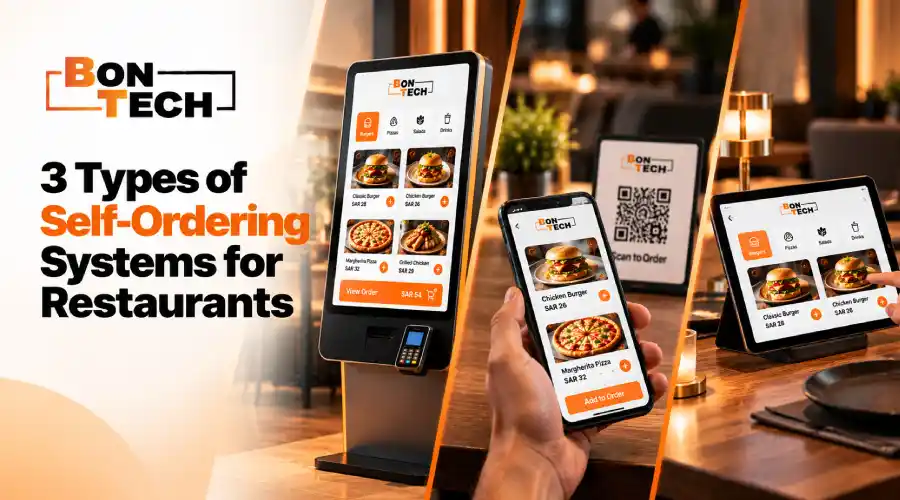
Not every restaurant needs the same setup. Your ideal self-order restaurant technology depends on your layout, customer journey, menu, service style, and daily order volume.
1. QR Code Ordering
QR ordering is one of the simplest ways to introduce self-service ordering without investing in a large hardware setup.
Your customer scans a QR code using their smartphone, opens the digital menu, selects items, customizes the order, and places it directly from their phone.
This approach works particularly well for:
Cafés and casual restaurants
Dine-in restaurants
Food courts
Restaurants with high table turnover
Businesses that want to reduce ordering queues
BonTech’s QR Ordering solution lets guests scan, order, track, and pay from their phones, creating a direct digital ordering journey while connecting the experience to your restaurant operations.
This model also fits naturally into Saudi Arabia’s increasingly digital payment environment. According to the Saudi Central Bank, electronic payments accounted for 85% of total retail payments in 2025, compared with 79% in 2024.
So, if your customers are already comfortable using digital payments, giving them a faster digital way to order is a logical next step.
2. Self-Ordering Kiosks
Kiosks take self-ordering a step further.
Instead of approaching a cashier, your customer can use a dedicated screen to explore the menu, customize items, add extras, review the order, and complete payment.
This can be especially powerful for quick-service restaurants where speed and order volume directly affect revenue.
A well-designed kiosk can also present add-ons at exactly the right moment. Rather than depending on an employee to remember every upselling opportunity during a busy shift, the system can consistently highlight relevant combinations, upgrades, sides, or drinks.
Industry reporting has associated self-ordering kiosks with higher average order values and greater order throughput, although actual results vary depending on menu design, restaurant format, traffic, and implementation.
3. Mobile and Guest-App Ordering
A third option is to give customers an ordering experience through your restaurant’s mobile ecosystem.
For example, Bon App helps restaurants offer table reservations, ordering, and customer feedback through a dedicated guest experience.
This approach goes beyond completing one order. You can use it to build a longer relationship with your customers through repeat visits, feedback, and a more convenient ordering journey.
For restaurants focused on loyalty and customer retention, that difference matters.
Book a free trial of Bontech Point of Sale System (pos)
Key Benefits of Implementing Self-Ordering Systems in Restaurants
The biggest advantage of a restaurant self ordering system is not simply that customers can order without speaking to a cashier. The real value comes from what happens across your entire operation.
1. Serve More Customers During Peak Hours
Peak hours put your restaurant under serious pressure.
If ten customers arrive at once, your team suddenly has to take orders, answer questions, process payments, communicate modifications, and keep the queue moving.
Self-ordering gives customers another path.
Instead of making every customer wait for the same employee, you can allow several customers to browse and place orders simultaneously. That can help increase throughput and make your operation significantly more responsive.
The exact improvement will depend on your restaurant, but the principle is straightforward: fewer manual ordering steps can mean more capacity during busy periods.
2. Reduce Order Errors
How often does an order go wrong because a modification was misunderstood or an item was entered incorrectly?
A self-ordering interface lets customers select their choices directly.
This can make complicated orders easier to manage because customers can see available options rather than explaining every detail verbally.
Your kitchen then receives clearer information through an integrated workflow.
That is where connecting your ordering technology with your POS and Kitchen Display System becomes especially important.
3. Increase Upselling Opportunities
Your best upselling opportunity should not disappear simply because your cashier is busy.
A digital menu can consistently suggest:
Add a drink
Upgrade the meal
Add a side
Choose a larger size
Try a complementary item
You can structure these prompts around your actual menu and customer behavior.
The result is a more consistent sales process without putting additional pressure on your employees.
4. Give Customers More Control
Customers increasingly expect convenience.
They want to see the menu clearly, understand their options, customize their order, and know what they are paying for before confirming.
A strong self order restaurant experience gives them that control.
At the same time, your employees remain available to help customers who prefer personal service or need assistance.
Self-ordering should not mean removing hospitality. It should mean giving customers another convenient way to interact with your restaurant.
5. Connect Ordering With the Rest of Your Operation
This is where choosing the right technology matters enormously.
A standalone ordering screen may look impressive, but it will not solve much if your team still has to manually transfer information between systems.
BonTech brings POS, ordering, table management, KDS, inventory, loyalty, and reporting together in one connected restaurant management platform.
That connection allows an order to become part of your wider operational workflow instead of becoming another isolated system for your employees to manage.
Read more: Best POS System for Cafe – Saudi Arabia Guide 2026
Why Self-Ordering Systems Are Crucial for Multi-Location Restaurants
Managing one restaurant is challenging.
Managing five, ten, or twenty locations is an entirely different operational problem.
When you have multiple branches, consistency becomes critical. Your customers should be able to recognize the same ordering experience, menu structure, service standards, and operational logic across locations.
A restaurant self ordering system can help you standardize the customer journey while giving each branch the tools it needs to operate efficiently.
Consistent Ordering Across Locations
You can maintain a more consistent digital ordering experience across branches instead of allowing every location to develop its own process.
That makes training easier and gives your customers a more familiar experience.
Better Visibility Into Performance
Multi-location operators need reliable information.
Which branch sells the most? Which products perform best? When do orders peak? Which items are frequently customized? Where are operational delays appearing?
Integrated reporting can help you answer these questions using actual restaurant data rather than assumptions.
Easier Expansion
When your technology is built to scale, opening another branch does not have to mean rebuilding your entire operational system from scratch.
BonTech supports integrations with delivery platforms, payment processors, accounting software, and other tools through its open API. That flexibility becomes increasingly valuable as your restaurant group grows.
For a growing brand, scalable technology is not a luxury. It is an operational advantage.
Overcoming Challenges When Self-Ordering Systems Are Introduced in Restaurants
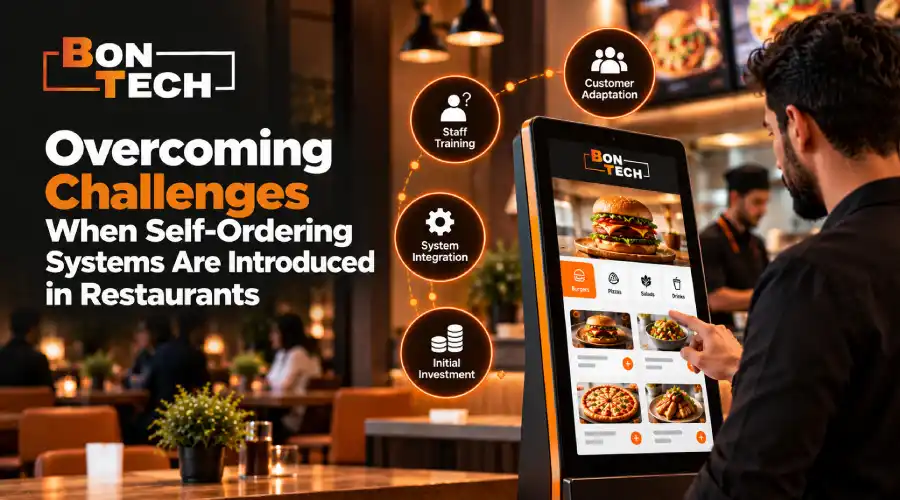
Self-ordering can be powerful, but installing technology alone will not guarantee success.
You need to introduce it properly.
Challenge 1: Customers May Need Guidance
Some customers will immediately understand the system. Others may hesitate.
Your employees should be ready to explain the process during the initial rollout. Clear instructions, simple menu navigation, and visible QR codes can make adoption much easier.
Challenge 2: Your Menu Must Be Easy to Navigate
A complicated digital menu creates the exact problem you are trying to solve.
Group items logically, use clear descriptions, make customization simple, and avoid forcing customers through unnecessary screens.
Your technology should make ordering easier—not turn it into a puzzle.
Challenge 3: Your Back-End Systems Must Be Connected
This is arguably the most important point.
If your self-ordering system does not communicate properly with your POS, kitchen, inventory, and payment systems, your employees may end up doing extra work.
That defeats the purpose.
BonTech addresses this through an integrated restaurant management ecosystem covering POS, QR Ordering, KDS, table management, inventory, loyalty, reports, and integrations.
Challenge 4: Technology Must Keep Working
What happens if the internet connection drops during your busiest hour?
For a restaurant, downtime is not a minor inconvenience. It can mean lost orders, frustrated customers, and unnecessary pressure on your team.
BonTech supports offline selling, allowing orders to continue when the connection drops and synchronizing data once connectivity returns.
That kind of resilience matters when your restaurant is expected to stay open and keep selling.
Read more: Food Cost Management: Cut Waste
The Future of Self-Ordering Systems: AI, Data, and Personalization
The future of the self order restaurant is not simply about putting a screen between your customer and your cashier.
The real opportunity is smarter decision-making.
AI and restaurant data can help businesses understand purchasing patterns, identify popular combinations, optimize promotions, and create more relevant recommendations.
Imagine a customer who regularly orders a specific meal. Instead of showing random promotions, your system could eventually use customer data to present more relevant suggestions.
The same data can help you understand operational patterns.
You could identify your busiest ordering periods, compare product performance between branches, monitor changes in average order value, and use those insights to make stronger decisions.
This is where BonTech AI can become part of a broader restaurant technology strategy.
The goal is not to add AI simply because it is popular. The goal is to use better data to make better decisions.
And as digital payments, mobile ordering, connected POS systems, and restaurant automation continue developing in Saudi Arabia, operators who build their technology infrastructure now will be in a much stronger position to adapt.
Saudi Arabia’s payment ecosystem is already moving rapidly toward digital transactions. The Saudi Central Bank (SAMA) reported 14.6 billion electronic payment transactions in 2025, up from 12.6 billion in 2024.
For restaurant owners, that shift creates a clear opportunity: make ordering, payment, operations, and customer engagement work together instead of treating each one as a separate process.
Make Your Restaurant Faster, Smarter, and Easier to Manage with BonTech
If you are ready to build a stronger restaurant self ordering system, BonTech gives you more than an ordering tool. You get a connected restaurant platform backed by more than 5 years in the market, +16M sales processed, and 450K successful transactions. From POS and QR Ordering to KDS, table management, inventory, reports, and integrations, BonTech helps you simplify daily operations while supporting your next stage of growth.